Friday, November 14, 2014

Salutations From Salzburg (Day 25 - GToE)

I have arrived safe and sound in Salzburg. I must say even thought I've only been here a few hours, I'm digging this picturesque city. Because it's right across the border from Bavaria, it has a very Bavarian feel, which I adore!

First let me give my thoughts on Vienna. Even though I spent way too much money, I really liked Vienna and if push came to shove, I could live there. With a population of 1.7 million, it's a little busier and bigger than I would like, but it is a nice, clean, safe city with a ton of stuff to do. Comparatively, at 150,000 residents, Salzburg is slower and smaller which is why I think I'm going to like Salzburg a little better than Vienna. 

Today, I completed the Rick Steves walking tour of Salzburg's Old Town. It started in Mozartplatz where the commemorative statue of the great man stands. It doesn't look much like him, but all the same, he's a hometown hero. By the way, did you know that Mozart was not Austrian? He would be a Salzburger. Salzburg was its own principality when Mozart was alive. But I digress. I toured the Old Residenz of the prince archbishop (sadly, the state apartments were closed) and the Cathedral. I meandered though St. Peter's Cemetery and checked out the catacombs. Unlike other cities, Salzburg's catacombs are located in the cliff of a mountain. Interestingly, at the catacomb entrance is a chapel carved into the hillside, which holds the tombs of Mozart's sister, Maria Anna, and Joseph Haydn's younger brother, Michael (also a composer of note). Maria Anna would probably have been as equally celebrated as her brother, had she been born in a different time. She was quite the accomplished musician.

Upon leaving the cemetery, I checked out St. Peter's Church and the area where the Salzburg Music Festival happens each year. Then, I meandered down Salzburg's main shopping street (Getreidegasse). I saw the establishment (Sporer) which serves homemade spirits. Sadly, there's a McDonald's on this block in addition to the rest of the annoying commercial stores. I eventually got to the place I was heading for: Mozart's Birthplace!

You're probably already tired of my Mozart affection, but I seriously love him and his music. Seeing the actual birthplace is a treat for the true Mozart lover. The museum covers three floors and begins on the top floor, where the family was living when he was born. I saw Mozart's first violin that he learned to play by the age of 6. The instrument was placed in the very room where Mozart was born. There is also a clavichord that Mozart played and wrote some of his most famous operas on (see photo). There is plenty of background information on Wolfgang and his entire family, plus some interesting tidbits about Mozart's world travels. He spent about one third of his life traveling. Sadly, photography is not allowed (although a borrowed a couple of photos from the website).

Upon leaving the museum, I walked around a little more and then decided to tour the Salzburg Museum. Mostly, I was underwhelmed with this museum. One floor of the museum was everything you ever wanted to know about Salzburg and First World War - something I don't have much interest in. The other floor traced the history of Salzburg, which is a little more interesting.

I decided to return to my hostel in order to check in and get settled. It's after 6:00pm and time to think about where to go for dinner and perhaps find something entertaining to do tonight. Although I should probably do laundry. Be sure to check out Day 25 photos on my GToE photo site.
The Hohensalzburg Fortress - checking this out tomorrow!

Thursday, November 13, 2014

A Museum Kind of Day in Vienna (Day 24 - GToE)

While it never actually outright rained today, the sky kept looking very threatening. I took advantage of the so-so weather and spent much of my day indoors, exploring various museums.

The day started with the Kunsthistorisches Museum. This gorgeous museum was built expressly to showcase the grandeur and opulence of the Habsburgs' collected artwork. Built in 1888, this world class museum showcases some of the finest masterpieces in the world. A short list of artists represented are Raphael, Caravaggio, Velázquez, Dürer, Rubens, Vermeer, and Rembrandt. In addition to all these famous artists, the museum offers a fine display of Egyptian and classical arts. Now I've mentioned that I'm not much of a fan of Renaissance artwork and much of the Kunsthistorisches is just that, so it was not the most thrilling time spent in a museum. (Raina would have loved visiting this museum.) But there were some paintings that I found interesting enough to shoot a photo. I really enjoying touring the Egyptian and classical arts so much more.

I next went across the street to explore the Hofburg New Palaces Museum. Yet another collection of the Habsburgs. Technically, the New Palaces is three separate museums in one building. The Arms and Armor Collection, the Ancient Musical Instruments Collection, and the Ephesus Museum. The Arms and Armor Collection is pretty self explanatory - rows upon rows of armor and weapons. Not my cup of tea. I loved the Ancient Musical Instruments Collection, which shows musical instruments through the ages including (supposedly) Beethoven's clarinet, Leopold Mozart's violin, and two pianos played by Wolfgang Mozart. Now how much of that is true...<shrugs>. The Ephesus Museum has artifacts from an ancient Roman city. I really only spent a considerable amount of time with the musical instruments. Fascinating stuff.

After leaving the New Palaces Museum, I headed off to the Hofberg Treasury. This museum contains a stunning collection of royal regalia - sparkling crowns, jewels, gowns, and assorted Habsburg bling. Man, were these people rich! The treasures include the crown of the Holy Roman emperor, Charlemagne's saber, and a ton of precious gems. There was one display that showed a piece of the "true cross" that Jesus was crucified upon (or so they say).

I then took a walk to Judenplatz, an area of Vienna which once had a thriving Jewish community in the Middle Ages, that is until Albert V ordered the annihilation of the entire Jewish community. Judenplatz has a memorial to all the Austrian Jews who were victims of the Holocaust. It's a moving monument with a unique design of being a library turned inside out. There are rows and rows of books with the bindings turned inward. Behind the memorial is the Museum Judenplatz, which has displays on medieval Jewish life and the remnants of a medieval synagogue below street level, which was discovered when they were excavating for the memorial. There is a second museum (Jewish Museum Vienna) a couple of blocks away, which documents the Viennese Jewish community from before 1938 through the present day. 

That was pretty much my day today. The only thing left is to grab some dinner and then get a good night's sleep because I have a 7:30am train to Salzburg tomorrow. Check out all my Day 24 photos on my GToE photo site.

Wednesday, November 12, 2014

Palaces and Music in Vienna (Day 23 - GToE)

My second day in Vienna was just as busy as my first day and it was glorious! Again, I thought about bitch-slapping a tourist, but thought better of it.

First, let me talk a little bit about the ballet Romeo and Juliet from last night. I arrived nice and early for the 8pm show, had a bite to eat and a beverage, before settling down in my seat. My seat was way up in the rafters but with a little maneuvering I was able to see the entire stage. I predicted correctly that I would not be able to stay for the entire programme because I had terrible back pain and was utterly exhausted (I almost fell asleep a couple of times during the first act). I managed to make it through the balcony scene, which ends the first act. I then went back to my hostel. But for the little bit that I saw, it was amazing. Beautiful staging, costuming and dancing. I'm only sorry that I was too tired and in way too much pain to enjoy it as much as I wanted.

After a decent night's sleep, I was off to the races again. I jumped onto another hop-on/hop-off bus tour (my ticket was a 48-hour one), which took a different route than yesterday. Today, I went to the summer residence of the Hapsburgs, the Schönbrunn Palace. The 1,441 room palace is spectacular and rivals Versailles in France for its opulence. Is it any wonder that the peasants would occasionally have a uprising when you see the splendor of these palaces? The tour that I took only covers 40 rooms and comes with complimentary audio guides. The guides had nearly the same commentary as yesterday's Hofburg palace, which is unsurprising. I was so thrilled to see the room in which six year old Wolfgang Mozart played for and completely charmed the Empress Maria Theresa. Again, there are no photos allowed. GRRRRR. After touring the state rooms, I meandered a bit around the grounds, which are probably spectacular in late spring and summer, but are pretty uninspiring in late autumn. But it is less crowded during this time of the year.

Upon leaving the palace, I stopped by Belvedere Castle, which was the summer residence of Prince Eugene of Savoy, now turned into an art museum. The Upper Belvedere houses great works of art from many of Austria's most famous artists, but particularly Gustav Klimt. Let me tell you something, Vienna loves Klimt! Now I know he's a hometown boy and they have every right to be proud of him and his paintings, but you can't swing a dead cat without hitting a Klimt museum. The artwork in the castle covers of the different eras and was fascinating. Again, no photos allowed.

I followed up my two palaces with two music museums. The first was the House of Music, which is a unique interactive museum dedicated to music. The first floor features an exhibit on the Vienna Philharmonic. The second floor presents a "sonosphere" which allows the visitor to discover the nature of sound and music. The third floor features audio/visual exhibits of Vienna's best loved classical musician/composers (Haydn, Mozart, Beethoven, Schubert, Strauss, and Mahler). Finally, at the end of the museum you can pick up a baton and virtually conduct the Vienna Philharmonic. Very, very fun, but not nearly as interesting as my final museum of the day, which was...

Mozarthaus!!! Mozarthaus is located in the only surviving Mozart residence in Vienna. This museum is really for the Mozart enthusiast (aka: moi). Mozart lived in this apartment from 1784 to 1787, during which he composed one of his most well known operas, The Marriage of Figaro. The museum encompasses three floors. The tour starts on the third floor which gives background information on Mozart and the time period in which he lived. The second floor is devoted to Mozart's operas and his death. The first floor is the actual apartment in which the Mozarts lived and focuses on the floor plan. But unless you really love Mozart (and I do), this museum might not be for you. I loved it!

Then it was time for dinner. As I hadn't had any lunch, I was ready to gnaw my arm off, but I decided that I would prefer a traditional Viennese dinner. Therefore, I decided to order Wiener Schnitzel (a very thin, breaded and deep fried schnitzel made from veal) and potato salad with apple strudel for dessert. Yum!

Following dinner, I headed back to Schönbrunn Palace (a mere 15 minutes away via the subway). You see, I was talked into purchasing tickets for the Schönbrunn Palace Orchestra which was performing tonight. Actually, they perform every night at the Orangerie in the Palace, but tonight was  special concert which was taking place in the palace itself. It was a little pricey (€55), but worth every penny. The orchestra consisted of 7 musicians (2 violins, a viola, a cello, a bass, a clarinet, and a piano), plus two vocalists (a soprano and baritone). The music presented was Mozart and Johann Strauss (the Younger). The first half is Mozart and the second is Strauss, and it all was wonderful. The orchestra features the best music of both composers and were superbly performed, plus the performers seem to be enjoying themselves as much as the audience did. During the Strauss portion, I wanted to get up and dance...there's a reason he's called The Waltz King.

A most amazing day.  Day 23 photos are on my GToE photo site.  Enjoy!

Tuesday, November 11, 2014

Vienna, Baby! (Day 22 - GToE)

It's just a little after 6:00 pm in Vienna and have I had a very, very full day -- and it's not over yet. If you remember, I was scheduled to depart Prague around 11:30 last night, and so I did. I got into my 4 person sleeper car (which only had 3 people in it - including yours truly) and attempted to fall asleep. But the bed was roughly about as comfortable as sleeping on a slab of concrete so I didn't get much sleep last night. I was awakened at 6:00 am by the attendant delivering hot chocolate and a chocolate croissant for breakfast. Nice. The train arrived in Vienna at approximately 6:30 am. I caught the subway to my hostel and arrived at approximately 7:00 am. I didn't expect to be able to get into my hotel room - I thought I might just have to dump my bags and wait, but lo and behold, luck was on my side, my room was available. Again...nice! After dumping my stuff in my room and making my bed, it was time to explore Vienna. 

First, breakfast. Then, I purchased a hop-on/hop-off bus ticket to get myself orientated with the city. Afterward, I following a great self-guided walking tour from one of my favorite travel writers - Rick Steves. If you are ever traveling through Europe and need a good travelogue, look for Rick Steves. Here is the list of major sites I saw today: the Vienna Opera House (no tour today, tomorrow though...), Cafe and Hotel Sacher, the Albertina Museum, the Imperial Crypt for the Habsburg family, St. Stephen's Cathedral, St. Peter's Church, Loos' Loos (the fanciest bathrooms I've ever seen), the most expensive street in Vienna, and finally, Hofburg Palace. Whew, that's a lot for one day.  

I saw so much today, it's hard to pick my favorite. One of the highlights was the Albertina Museum, a former royal residence turned into art museum. It's interesting to be able to tour classic state apartments and magnificent modern works of art at the same time. The artwork housed is from the Impressionists through the Modernists and everything in between. My favorite paintings were from Monet, Picasso, Chagall, Beckmann, Munch, Kandinsky, and Warhol. A truly great museum.

St. Stephen's Cathedral was interesting, but not nearly as amazing as some other cathedrals that I've seen. Bonus points though for having a plaque honoring my man, Wolfgang Amadeus Mozart. 

The best site visited today has to be the Hofburg Palace. While the ground floors shows every possible piece of porcelain and silverware ever used in the palace is kind of a snoozefest (for me), the upper floors which consists of the Sisi Museum and the Imperial Apartments are well worth the price of admission. The Palace focuses on the life and times of Emperor Franz Joseph I and his wife, Empress Elisabeth ("Sisi"). Sisi was a bit of an enigma during her time as Empress and after her assassination in 1898, there was all sorts of stories told about her, mostly incorrect. The Sisi Museum is dedicated to telling Elisabeth's story and the Imperial Apartments are stunningly gorgeous. Sadly, photos were not allowed. But it certainly made me interested in knowing more about the Habsburgs, especially Sisi.

As I mentioned, my day is not quite over. I wanted to experience seeing something at the Opera House, so I checked what was available and decided to get a ticket for tonight's performance, Romeo and Juliet, a ballet by Russian composer, Sergei Prokofiev based on the famous play by Billy Shakespeare. I just hope I can keep awake until the end. I'm a little nervous about that. I have just about enough time to relax for a little bit before taking a shower and getting dressed for tonight. I will report on the performance tomorrow.

Day 22 photos are available on my GToE photo site.

Monday, November 10, 2014

My Last Day in Prague - The Castle! (Day 21 - GToE)

Well, I am finishing up my last few hours here in Prague. It's been a great time seeing my good friend, Raina, and seeing this jewel of a city. I highly recommend visiting Prague. My only complaint (and this complaint goes with every place I've visited and will visit) I effing HATE TOURISTS! Now, I know that I'm a tourist, but I never act like a tourist. I don't put my needs before everyone else's. I am polite and considerate and I wait my turn when at crowded attractions. But I cannot say that same for every other tourist. They are rude, mean douchebags and I hate them. 

Okay, now that I've gotten that off my chest: my last day in Prague has been mostly spent hanging out in the Castle Quarter. But before heading off to the Castle, I made a quick run across the river back to the Old Town Square in order to record the Astronomical Clock at the top of the hour (9:00am to be exact). You can watch the video below to see the clock's animations. You may have to watch it a couple of times to really see everything that's going on. Notice the skeleton (Death) ring the bell and flip over his hourglass, while the other three statues shake their heads. The Apostles make an appearance above and finally the gold rooster crows. Yep, it's amusing.

Then I wended my way up to the Castle. Now, in most European cities, the castle is the heart of the city and a place of fortification in the centuries past. Prague is no different. What is different about the castle, is that it's more of a fortified city within Prague. There's a multitude of different palaces and royal residences, a fortified wall, and a huge Gothic church. The royals could live quite happily in this castle quarter and never have to mingle with the riffraff (aka: the peasants). It is an amazing way to spend a few hours.

I arrived at the castle around 10am and proceeded straight to the cathedral - St. Vitus Cathedral. This site is the most prominent when looking up at the castle from down below. It's a strikingly beautiful building which began construction in 1344, but technically wasn't finished until 1929 - thanks to numerous factors (war, plagues, religious reform, and such). There is a beautiful Art Nouveau stained glass window (the Mucha Stained-Glass Window - see photo above), which is one of the major draws to this cathedral. Additionally, this cathedral is the burial sites of the first Habsburgs to rule Bohemia, St. Vitus, and St. Wenceslas.

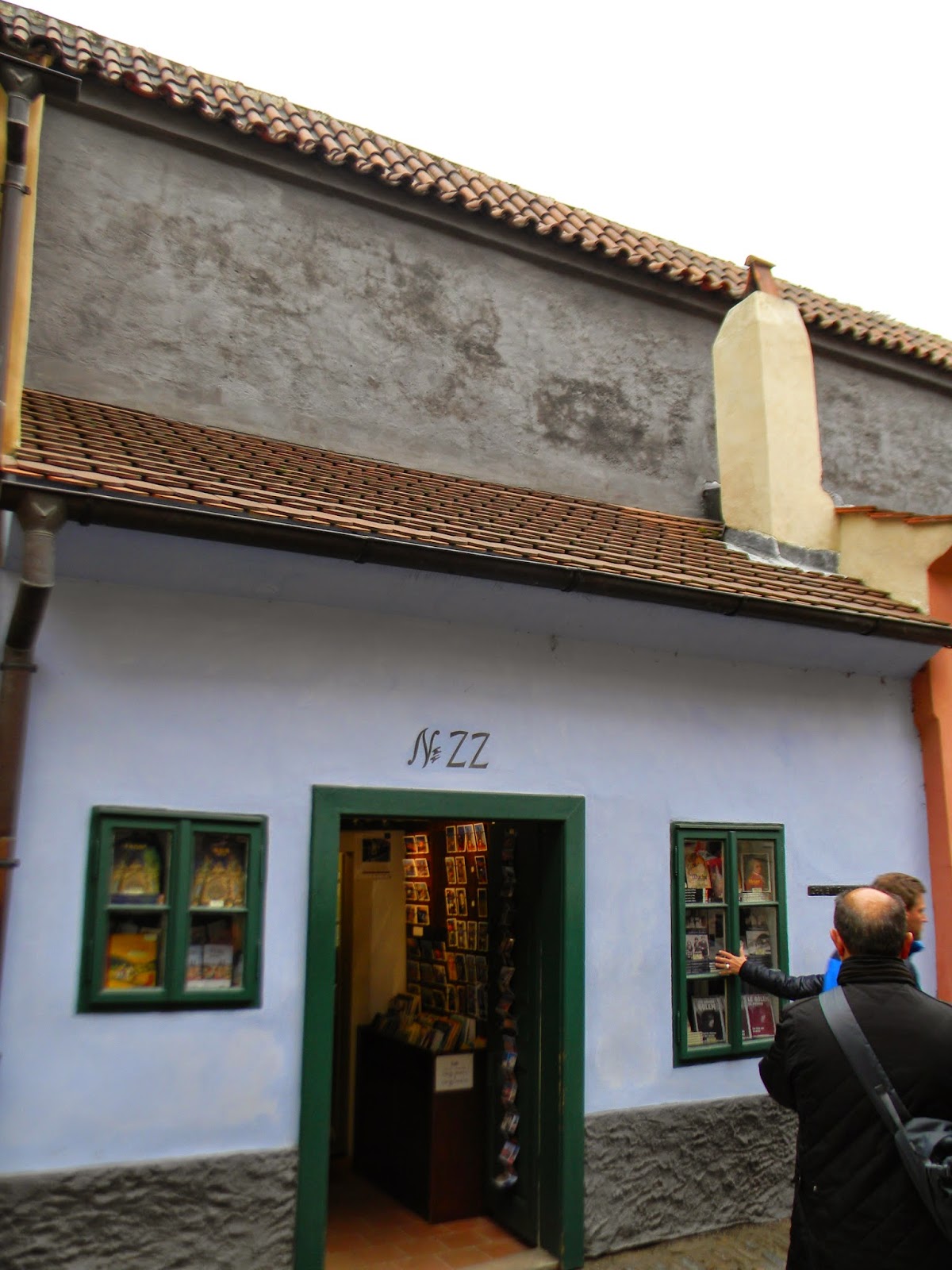
Kafka's House
After touring the cathedral, I popped in and out of a few other sites (the Old Royal Palace, the History of Prague museum, St. George Basilica and such). But by far one of my favorite places to visit was Golden Lane - a picturesque street of tiny old buildings which used to house castle servants and others. Up until World War II, these little houses were occupied - including one which Franz Kafka lived in for a short time (#22). These teeny tiny houses made my tiny NYC shit-box of a studio apartment look like a mansion. But they're incredibly quaint and just lovely.

Upon leaving the Castle, I made my way up the hill to the Strahov Monastery where I had lunch (new food of the day: boar (tastes like beef) and viewed the monastery's library. I didn't do much after that, except meet Raina for a final pot of tea before leaving Prague. Sadly, Raina had stuff to do today and couldn't spend the day sightseeing with me. But it was good to spend some final moments with her. The other good news is that my bank finally came through with my debit card. I'm back in business. Yipee!

My final thoughts on Prague: as so many people have said before me, Prague is quite beautiful and it's an amazing place to visit. For every ex-pat that I've spoken to, it's an amazing place to live too. I would definitely put this city on the short list of places that I would move to if I had the opportunity.

Tonight, I'm on the midnight train to Vienna, where I will hopefully get to see all the major and not so major Mozart sights. I have a slight obsession with Mozart. Check out my Day 21 photos on my GToE photo site. (Warning: LOTS of photos today!!)


Sunday, November 9, 2014

More From Prague (Day 20 - GToE)

It is Sunday night in Prague and yet another amazing day in this magical city. I can certainly see why my friend, Raina loves this city. I could definitely live here, except that I don't think I would ever be able to learn to speak Czech.  

I started my day by checking out one of Prague's best known sites - Old Town Square, which has been a market square since the 11th century. The focal point of the square is the ancient Astronomical Clock, which was installed in 1410, making it the third-oldest astronomical clock in the world and the oldest one still working. Don't ask me how to read it because I don't understand it, but it's an fantastic clock. At the top of the hour, the figures on the clock move, the heads of the Apostles make an appearance, and a rooster crows before the bells toll the hour. I attempted to make a video of it today but it didn't come out very well. I'll try again tomorrow now that I know what I'm looking for. 

After watching the clock toll the hour, I meandered a bit around the square and viewed the churches (the Tyn Church and the Church of St. James) - while waiting for Raina to show. Both churches were beautiful, but the Church of St. James has an interesting relic - a black, shriveled-up arm with clenched fingers which is hanging by a chain from a metal post right near the main door. Apparently, a thief attempted to steal an important treasure from the church, but his hand froze to the statue. The monks had to cut off his arm to get the hand to let go. The arm was hung as a warning. That's messed up!

When Raina finally caught up with me, we decided we would explore the Jewish Quarter. In this quarter, there are several Jewish sights scattered over a three-block area: the Old-New Synagogue, the Maisel Synagogue (current closed), the Pinkas Synagogue, the Spanish Synagogue, the Old Jewish Cemetery, the Ceremonial Hall, and the Klaus Synagogue. With the exception of the Old-New Synagogue and the Maisel, Raina and I visited all the other sights. Each one tells a different part of Jewish life and all are interesting museums to visit. But for me, the best and most important of all of these sites was the Pinkas Synagogue.

Built in 1535, the Pinkas Synagogue was a site for Jewish worship for 400 years, and is currently a memorial to the Jewish victims of the Holocaust from Bohemia and Moravia. The walls are covered with the handwritten names of 77,297 Czech Jews who were sent to the gas chambers. I can't even being to describe the impact that this site has for me. Of all the memorials to the victims of the Holocaust, the Pinkas is one of the most moving. I spent about 3 minutes looking at the names before I burst into tears. It's just overwhelming the sheer number of names on the walls. This memorial is a must see for anyone who visits Prague. 

Here's a little history on Jewish population in the Czech Republic. "For the Czechs of the Protectorate Bohemia and Moravia, German occupation was a period of brutal oppression. The Jewish population of Bohemia and Moravia (117,551 according to the 1930 census) was virtually annihilated. Many Jews emigrated after 1939; approximately 78,000 were killed. By 1945, some 14,000 Jews remained alive in the Czech lands. Approximately 144,000 Jews were sent to Theresienstadt concentration camp. Most inmates were Czech Jews. About a quarter of the inmates (33,000) died in Theresienstadt, mostly because of the deadly conditions (hunger, stress, and disease, especially the typhus epidemic at the very end of war). About 88,000 were deported to Auschwitz and other extermination camps. When the war finished, there were a mere 17,247 survivors. There were 15,000 children living in the children's home inside the camp; only 93 of those children survived" (Wikipedia).  There are currently only about 1,700 registered Jews in Prague, although there are probably more who are unregistered. After their experiences with the Nazis and, later, the Soviets, can you blame them?

After visiting all of various sites in the Jewish Quarter (and having stopped for lunch during the afternoon where I had some yummy goulash), we then decided to check out the Museum of Medieval Art, before heading off to a few other sites, like Wenceslas Square and Náměstí Republiky, plus stopping for the occasional bite for food or beverage. 

Tomorrow, I'll be heading up to Prague Castle, which I cannot wait to see. I'm not certain what else I'll do tomorrow but the Castle is a definite! Remember to check out my Day 20 photos at my GToE photo site.


Saturday, November 8, 2014

Being Bohemian in Bohemia (Day 19 - GToE)

Sedlec Ossuary
Today, the sun finally decided to show itself! Yay!!! Also, today, Raina and I decided to take a side trip out of Prague. A friend back in the US had told me that I should visit a castle village called Český Krumlov which is located in southern Czech Republic, but last night, Raina and I decided that it was a titch too far to travel for one day, so instead we went to Kutná Hora.

Located approximately an hour (by train) outside of Prague, Kutná Hora is a city situated in the Central Bohemian Region of Bohemia and it is considered an authentic Czech town. It is picturesque and it was an amazing day. 

We started our visit to Kutná Hora by visiting Sedlec Ossuary (also known as "The Bone Church"). The ossuary is "estimated to contain the skeletons of between 40,000 and 70,000 people, whose bones have in many cases been artistically arranged to form decorations and furnishings for the chapel. The ossuary is among the most visited tourist attractions of the Czech Republic, attracting over 200,000 visitors yearly" (Wikipedia). The bones were gathered from the victims of the plague and those who died during the Hussite wars. It was pretty wild seeing all these bones from 400 or so years ago, which had been put into rather bizarre designs including a chandelier that has a representation of every human bone.

After leaving the ossuary, we walked down the hill to the Church of the Assumption of Our Lady and St. John the Baptist, which is a Gothic and Baroque Gothic church. The church was built in the 1300s, but went through major reconstruction in the 1700s. It is a pretty church but rather uninspiring when comparing it to the next church we visited which was...

Babs's House
Church of St. Barbara (or as we started calling "Babs's House"). The church is in the style of a Cathedral and is a beautiful example of Gothic architecture. Outside there are flying buttresses and gargoyles which made me very happy. Construction began in 1388, but "because work on the church was interrupted several times, it was not completed until 1905" (Wikipedia). The painted glass windows and the medieval frescoes are not to be missed. 

We then meandered around this pristine, gorgeous town and finally had dinner in a typical Czech restaurant. It was a magical day. 

After returning to Prague, Raina and I were both tired so we decided to call it a night. I came back to my hostel, did some laundry, took a shower, and will soon be heading off to bed. Although at the moment, I'm bonding with some of my fellow bunkmates who are both from the US. It's been a great day. I know I've repeated that a lot but it was a fantastic day!!

By the way, I love Prague and the Czech Republic. This is a place that everyone should visit.


Kutná Hora